
The Cresort Ghana — Full Network Overhaul and Managed Service Deployment
How IJA Technologies transformed the network infrastructure at The Cresort Ghana — from unreliable consumer-grade WiFi to a fully managed, monitored enterprise network across 18 acres.
The Client
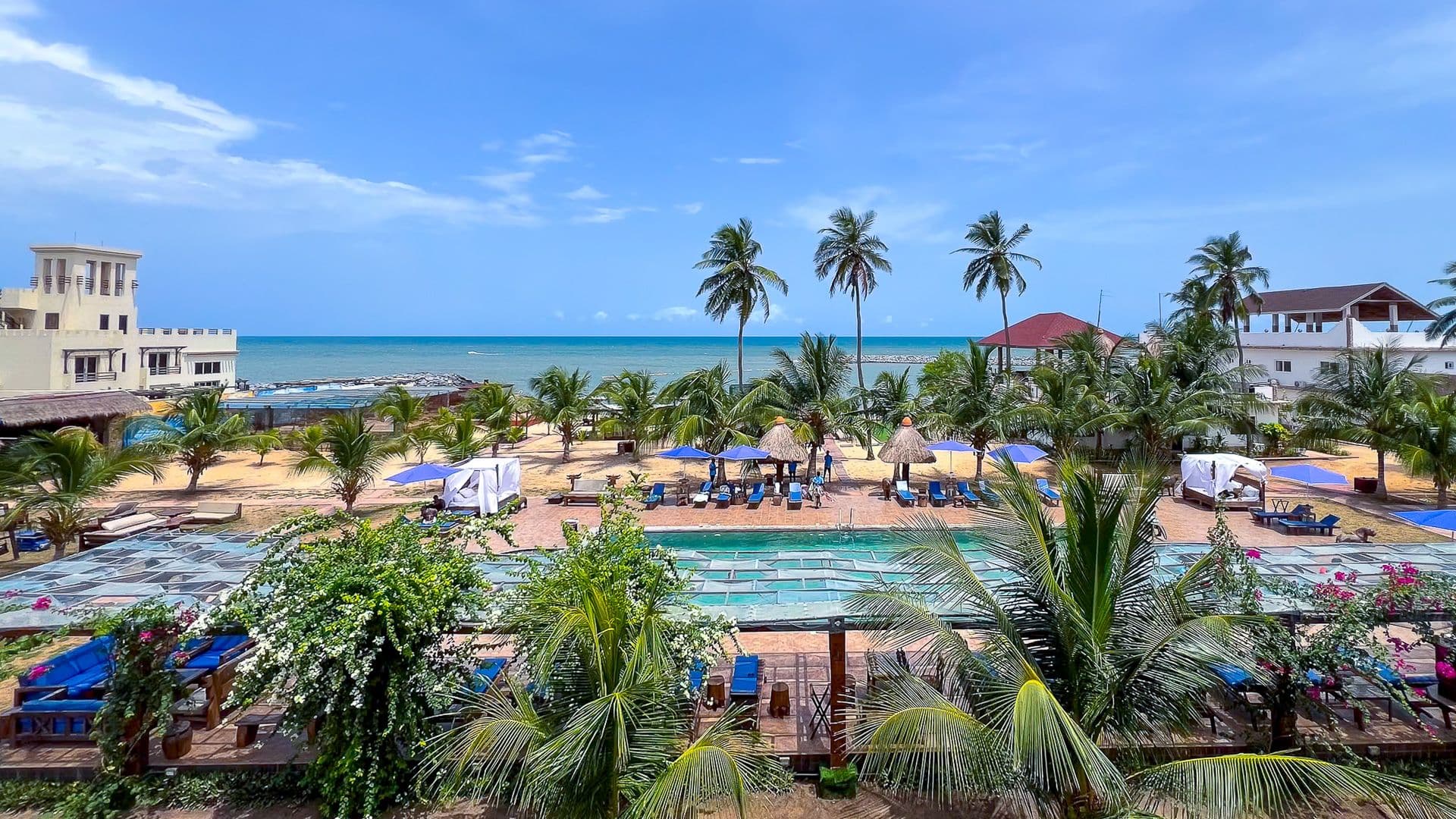
The Cresort Ghana is a coastal resort property spanning 18 acres on the Ghanaian coast. The property operates guest rooms, restaurants, a pool, and beach facilities — with WiFi expected across every area. A POS system runs the food and beverage operation. Staff, guests, and management all depend on the network every day.
The Challenge
The Cresort came to IJA Technologies because they were unhappy with their existing service provider and wanted a change. The owner — candid and direct about the problems — described a network that was unreliable, unsupported, and increasingly a source of guest complaints.
When IJA conducted the initial survey, the picture became clear quickly.
The property was running Starlink as its sole internet connection. On a good day, throughput reached 40Mbps. On a bad day, it dropped to 10Mbps. For a resort property with guests streaming content, staff running a POS system, and management depending on cloud applications, the variability alone was a significant operational problem.
The WiFi infrastructure was worse. The property had accumulated a collection of Ubiquiti access points deployed on wall mounts and on top of cupboards — placements that compromised coverage and performance. There was no central controller. Each access point was managed independently, with no visibility into the network as a whole, no VLAN segmentation, and no way to prioritise or isolate different types of traffic.
A single flat network meant guest devices, staff devices, and the POS system all shared the same network with no separation. This was a security and performance problem simultaneously.
The cabling infrastructure had deteriorated. Faulty ethernet and fibre runs were causing intermittent failures that were difficult to diagnose without proper tooling.
IJA's estimate after the survey: the property was operating at approximately 30% of the network performance it should have been delivering to guests and staff.
The Conversation That Set the Tone
Before agreeing to take on the project, IJA's founder Gregory had a direct conversation with the owner.
The position was straightforward: IJA would not provide internet service to the property unless the network infrastructure was brought up to a standard that would allow the connection to perform. Delivering a fast internet connection into a broken network is not a solution — it is a liability.
The owner agreed. The scope was set: a full network overhaul, followed by an ongoing managed service contract. IJA would own the outcome, not just the uplink.
This is how every IJA engagement begins.
The Deployment
What We Found
The survey revealed the full scope of the problem:
- 28 WiFi access points, none centrally managed
- Access points mounted on walls and furniture rather than ceilings — fundamentally compromising coverage patterns
- Four flat unmanaged switches with no VLAN capability
- Faulty ethernet and fibre cabling causing intermittent connectivity failures
- No network segmentation — guests, staff, and POS on the same flat network
- Single internet connection with no failover
- No monitoring, no alerting, no visibility
What We Built
Switching infrastructure. All four flat switches were replaced with Ubiquiti managed switches, chosen to integrate cleanly with the existing Ubiquiti access point estate. Spanning tree protocol configured to eliminate broadcast storms and provide loop protection across the network.
WiFi infrastructure. Existing access points were relocated from wall and furniture mounts to ceiling positions — the correct placement for coverage and performance. Additional access points were installed to fill coverage gaps across the 18-acre property. All 28 access points were onboarded to IJA's Ubiquiti controller, hosted on AWS London, providing centralised management and visibility for the first time.
Three segmented networks. Three separate WiFi networks were created, each on its own VLAN with its own speed limits and access policies:
- C Admin — management and administration
- C Staff — operational staff
- C Guest — guest-facing network, isolated from all business systems
Guest devices cannot reach staff or admin systems. The POS network is separated from guest traffic. Each segment has defined bandwidth limits.
Connectivity. IJA worked with Teledata to establish a Fixed Wireless Access point-to-point connection to the nearest tower, delivering approximately 200Mbps of throughput — a dramatic improvement over Starlink's variable performance as a sole connection.
Dual WAN failover. The MikroTik router was configured with automatic failover between the Teledata FWA connection (primary) and Starlink (secondary). If the primary connection degrades or fails, traffic moves to Starlink automatically. Sessions are maintained. The failover is invisible to users.
Active queue management. CAKE/fq_codel was deployed on the MikroTik router to eliminate bufferbloat — ensuring that the connection performs consistently under load, not just when the network is quiet. Every device on the network benefits from low-latency performance regardless of what else is happening.
Configuration versioning. Oxidized was configured to fetch the router configuration every hour — meaning every change is versioned and any configuration problem can be rolled back immediately.
Network monitoring. Zabbix was configured to collect continuous telemetry from the router — latency, packet loss, interface health, and system metrics. This data forms the foundation of IJA's ongoing managed service SLA.
The Reality of the Deployment
The initial estimate was two days. The actual deployment took seven days of 12 to 14-hour work.
The scope of the cabling problems, the extent of the access point repositioning required across 18 acres, and the complexity of bringing 28 previously unmanaged devices into a properly segmented and controlled network all took longer than anticipated.
This is the reality of infrastructure that has been neglected. The right response is not to cut corners to hit a timeline — it is to do the work properly. IJA stayed until the network was right.
The Outcome
The property moved from approximately 30% network performance to over 90% — IJA's estimate based on the survey findings and post-deployment assessment.
Guests now have reliable, segmented WiFi across all areas of the 18-acre property. Staff operate on a separate network. The POS system runs in isolation from guest traffic. Management has a connection that does not drop when the primary link has a bad day.
The network is centrally managed from IJA's Ubiquiti controller. Every access point is visible. Every configuration change is versioned. Zabbix is collecting continuous telemetry.
Two final steps remain before the project is formally closed. A Raspberry Pi will be installed on the property running two continuous probes: PingPlotter measuring real-time latency, packet loss, and jitter from the premises outward, and iperf3 running scheduled throughput tests to IJA’s AWS server in London — measuring true internet performance, not local CDN speed. This telemetry will feed into Zabbix and surface in a Grafana dashboard that the owner will be able to access directly. When complete, The Cresort will see exactly what IJA sees — in real time. That is the IJA Verify promise.
What This Engagement Demonstrates
The right conversation at the start saves everyone. Being direct with the owner about the infrastructure requirements before agreeing to provide internet service set the right expectations and the right scope. There were no surprises about what the work would involve.
Infrastructure problems compound. Faulty cabling, wrong access point placement, flat networking, no segmentation — none of these are individually catastrophic. Together, they produce a network that fails at the level the guest actually experiences it. Fixing them properly requires addressing all of them, not just the most visible one.
Seven days is the right answer when two days is wrong. The deployment took longer than estimated. The alternative — cutting scope to hit the original timeline — would have left the property with a partially fixed network. IJA does not do that.
Monitoring is not optional. Zabbix telemetry, Oxidized configuration versioning, and the forthcoming Grafana dashboard mean that IJA can see what is happening on this network before the owner or the guests do. That is what makes the SLA contractual rather than aspirational.
IJA Technologies is Ghana's carrier-agnostic managed technology partner. If your property is experiencing network problems that your current provider cannot resolve, talk to us.
Trust and Verify.
Every key account gets a dedicated account manager and access to their own Grafana dashboard. You see exactly what we see, in real time. That's not a promise — it's a login.
Start with a network audit